donderdag 1 oktober 2009

The blind in greek mythology!

For my research on how we perceive the blind throughout the years I decided to look at the greek mythology. The blind are common in these stories and always connected to the divine. Here is a small summary of blind people in greek mythology:

Polyphemus- What? Cyclops in the story of Odysseus. How? He was blinded when Odysseus escaped the island of the cyclops.
Phineus- What? King and seer in the story of Jason and the Argonauts. How? Phineus was given the gift  of prophecy by the goods, but had to choose between being blind and living a long life or seeing and have a short life. This because he revealed the discussions of the gods to the people. The god Helios, the god of the sun, was angry for Phineus to choose the darkness over 'his' sun and sends his harpies  to prevent Phineus from eating more than necessary. His torment ends when Jason kills the harpies.
Tiresias- What? Blind prophet from the stories of Odysseus, Oedipus and others stories . How? There are two stories of how Tiresias became blind. The first story tells that he got blinded as punishment for revealing secrets of the gods to the people. The second story tells that he was blinded by the goddes Athena, after seeing her naked taking a bath.
Oedipus- What? Son of the king of Thebes and lateron King of Thebes. How? The story of Oedipus is a  tragic story about a prophecy (by the blind seer Tiresias) of the king and queen of Thebes who will get a son, and this son will grow up to kill his father and marriage his mother. After the queen gave birth of a son the king gave the son away to a shepherd with the assignment to kill him, in order to stop the prophecy. Instead of killing the boy the shepherd gave the boy away to another family, who raises him as there own. After a couple of years, when he founds out he is adopted, he travels to the blind seer in order to get some information. Tiresias tells him the same prophecy and scared that he would do these horrors he decided to leave. In his travels, on a crossroad, the father and son meet each other and they quarrel over who may pass first. In the fight that happens Oedipus kills his father without knowing he is his father. Oedipus continuous his travels and on his way he defeated the sfinx that haunted the travelers of Thebes. Because the king of Thebes was dead by a unknown killer and because Oedipus killed the sfinx the people of Thebes crowned Oedipus to be there new king. He married the queen without knowing she was his mother. And together they got 4 children. After a couple of years disaster stroke the city of Thebes and the oracle told that only punishing the killer of the old king could bring back peace. After a will Oedipus found out that the man he killed was the old king and his father. The queen found out at she married her son and killed her self. After Oedipus found his wife / mother dead he poked out his eyes and let his daughter guide him out of the town in order to stop the curses that befell the city of Thebes.


Interesting about all these examples from the greek mythology is that their blindness is a punishment. In the stories of Phineus and Tiresias it was the sin of meddling with the affairs of the gods. While in the story of Polyphemus and  Oedipus it was done by man. Prophets and seers are often pictures as blind men. They are often respected for there knowledge and wisdom, but they where also feared, because of their divinity.

woensdag 30 september 2009

Book review: The Blind in French Society from the Middle Ages to the Century of Louis Braille!

I found the book: The Blind in French Society from the Middle Ages to the Century of Louis Braille , by Zina Weygand and Emily-Jane Cohen. Like the title suggest, the book gives a overview of the developments of the blind in France. The chapters I could read so far described the image of the blind in de middle ages. He starts with explaining the number and the causes of blindness and he compares this with the present causes and numbers in third world countries. "Malnutrition , lack of hygiene and infectious diseases"(p.11) together with violence and accidents are causes for blindness. But also blindness was a punishment inflicted on thieves. From the church there was a believe that the blind were people which got punished for a sin they have done (or their parents).
All these causes brought forth a image of the blind that was especially negative.

"the lame and the blind ... are too lowly to be mentioned in front of good and honourable persons; if nature has refused them to this point and stigmatized them, it is because they have a sin expiate."(p.16)

This negative image was visible in theatres were the blind provoked laughter at their own expense. Blind people were there "to poke fun at them"(p.13)One play tells about a blind man and a young boy: The blind man wants a help and finds it in the form of a young boy. But the story turns in deception and the boy steals the saving money of the old man. This money was gathered by began. The old blind man used his disability to collect charity money from the rich, thus making him rich. When the play develops, the blind man shows more of his real nature, as a drinking lying man. This is why the audience doesn’t feel pity when the young boy steals the money of the blind man.

"The public, therefore, will not pity him when his valet strips him of his possessions, taking leave with these words, which express all the competent that could be had for blind beggars at that time."(p.14)

These were the condition the blind had to live in the medieval ages. But these times were not only this cruel. “the church demonstrated much more charitable behaviour towards them at the same time”.(p.17) The care of the (poor) blind, in these times, was done by the church. In hostels (and later on almshouses) the blind, together with people with other disability, the sick and the mentally ill, were taken care off. Religion used these hostels to cure the people in the name of god, which brought the blind to seek them out for forgiveness and salvation. This charity of the church was adopted by rich and wealthy in order “to show off their riches and grandeur” (p. 18), leading to the first institutions founded especially for the blind in the eleventh century. The first blind institute was the Quinze-Vingts (=300, stands for the number of beds available for the blind).

The negative view of the blind, of drunk and lying beggars, stayed for long. Until the humanist Juan-Luis Vivès wrote his theory about the fact that everyone who can work, must work. Vivès believes that even disabled people, like the blind, can work.

“Not even the blind shall be allowed to remain idle; there are many things they can do. Some have literary disposition, provided that someone read to them. Let them study, for we observe that a number of them make progress in erudition ... In sum, if they neither wish to be unemployed nor to flee work, they will easily find something to keep them self occupied. Laziness or indolence, and not a bodily defect, is the only excuse they may put forward for doing nothing.” (p.28)

By claiming “the law the lord imposed on all mankind”(p.29) Vivès makes the blind (and other disabled people) equal with healthy people. Seeing them as ‘a whole”(p.29). He was one of the first to claim this. The enlighment period which brought forth a rational worldview changed the negative image of the blind into a possibility to integrate into the ‘normal’ world.

Interesting is the image this book sketches of the church. At one hand the religion contributes to the negative image of the blind, by claiming that blindness is a punishment for a sin. At the other hand it is the church that provides shelter and care for the poor blind. He sketches this duality also for the charity houses of the rich and wealthy, which are for charity and for showing off wealth.


The text self can be found in pdf form here

vrijdag 25 september 2009

Analyzing stories!

For analyzing the three locations I came up with the following story: In the book 'City of the blind' by José Saramago creates a world where he transforms blindness into a metaphor for his critique on modern society. Blindness not only stands for the absent of vision, but for showing us what we are, in his eyes.

In the book the "crazy house", that houses all the blind that became infected by the blindness disease, collapsed and burns after the happenings inside reached its climax. The house, that sheltered and gave the people a place on earth, was gone. Most of the people where brought there blind and now have no idea where they are. They lost there link to the earth. Struggling to survive and re finding there place on earth again the story of José Saramago and my research intertwine. From here on we will follow three of the characters out of the book, how they will find there way around the chosen location of my project. There blindness will describe the area from there perspective. Sound, smell, touch, taste will be there world. Concept as time, distance, society, life and dead describe the area on a different level then you and me will see them. With the addition of sound maps and materials gathered from the area this story will provide a map of the area different from our view on the side.

Analyzing the areas on a sensory level and combining them with the story of 'the city of the blind' creates a concept not only formed by the absent of vision. But also one that criticizes modern society and our lack of vision.

The idea (until now!) is to finish the analyzes with a concept model for all three locations based on the analyzes of the area. In the msc 4 one off these models will be the base for the design which I will work out.

Location: Koopgoot

Here are some maps for the koopgoot location:

Map + underlayer:


Map without under layer:


Map nature and buildings:


Map roads and buildings:

donderdag 24 september 2009

Location: Ter Borg

Here are some maps for the Ter Borg location:

Map + underlayer:

Map without underlayer:

Map buildings + nature:

Map buildings + roads:

Location: Binckhorst

Here is some map material for the Binckhorst area
Map + underlayer:

Map without underlayer

Map buildings + nature:

Map Buildings + roads

Here is some map material for the Binckhorst area

vrijdag 18 september 2009

Location proposal #2

After thinking of possible locations for the blind institute I came up with three proposals, each with different qualities. The first one was already mentioned last in location proposal #1, namely the Binckhorst in The Hague. A interesting area, full of life and interesting sensory diversity. The master plan of the area shows that the area is transforming into dwelling, offices, companies and park. A contradiction to this location will be my second suggestion: around the koopgoot in Rotterdam. This area is surrounded by retail and leisure shops. It is a always busy and lively place, addressed to commerce. Different is the live around the koopgoot at night. The city of Rotterdam has a center where not many people live. How does this affect the blind? At day busy, lively, hasted, everything is addressed to this commercial way of life. At night empty.

Contradicting both The Hague and Rotterdam is my third proposal: Ter Borg in Schinnen. Ter borg is an old farm and castle located in Limburg at the border of a forest, surrounded by farming land. Close to the location is the train station of Spaubeek and the A76 highway from Eindhoven to Aken. How different is this area then the first two. The people, the work, the commerce, the hasting, the lively surrounding are not to be found here. Here nature takes that place. The forest, the air, the animals create a different kind of lively surrounding.

To select the best location for my institute, I will analyze the three location not only on traditional ways (think of mapping activities, routings, connections etc.). No I'm interested in the blind, so I will analyze the locations on a way a blind person will learn a area. Sound mapping, touching the surrounding and smelling the environment. But also creative writing, exploring an area through different perspectives. All these methods and more will give me an image, or maybe image is not the right word, give me an understanding of the location like the blind have and so choosing the best location.

donderdag 17 september 2009

Location proposal #1

Because my project is focussed on the methodology and not on a site, I am capable of choosing my own location to work on. But how to choose? A idea is to take 2 or 3 different sites. Each with there unique character and possibilities. The plan is to analyze these location on there diversity of senses, showing their lived space through analyzes through hearing, smelling, tasting, touching. But also through various literary techniques like creative writing and working with different characters, perspectives and time. By these methods I'm mapping the lived space of all the locations and placing them next to each other, in order to select the location I will work with for my design.

My first location to investigate is a proposal from Klaske Havik and is the Binckhorst area in The Hague. This site is a old industrial area which the city of The Hague has big plans for. The architectural firm OMA is working on a study of the area and there is a diversity of function already present (cultural, dwelling, commercial, industry). The site is located close to Holland Spoor station and the train is running next to it, just like the river "trekvliet". The diversity of life, the old industrial character and the train and water borders makes this area an outstanding place for a diversity of senses.

Other location will be added when I know them.

woensdag 16 september 2009

Just an idea! #1

This is just an idea for the context of the design proposal. After reading "exploration #6: the uncanny in Mark Z. Danielewski's 'house of leaves'" by Nele Bemong I notice a similarity between being blind and the "Unheimlich" (at least in my eyes, I don't know if someone who is blind agrees with me?). The text reminded me of the changing character of the house in the book. It started out as a haunted house, intruding in the lives of the Navidson's (the main characters in the book). But coming to the end of the book the house changed, it became not the enemy but almost something godlike. This changing was linked with the mental state of the navidson's and after being almost destroyed by the 'unheimlich' they understand it, accepted it and accepted their own mental state and therefor changing the house to the 'heimlich' again. This accepting and therefor changing the 'unheimlich' into the 'heimlich' sounds to me as a metaphor for being blind, and accepting that. I can understand that being blind turns even the simplest house into a maze giving it a 'unheimlich' feeling. After understanding and accepting that your blind this maze can become a simple house again, forming a 'heimlich' feeling. Ok, this only applies for people who turn blind later on in there lives, because they're not accustomed with there other senses yet, but it can be a concept for the institute.

You can read this essay about "house of leaves" here. And also start reading the book if you didn't do this already!!!

First structure Literature research

My goals for the literature research two things. First I want to study literature as a methodology for architecture. Tools like perspective, characters, time, description, detail, narrative, but also concepts like lived experience, creative writing, layout and poetry. With these tools and concepts a writers is capable of leading the reader to a world he designs and where the reader will live in it, finishing it. Words and more important narratives speak to a reader in a way that he understands, even feels the writer who he probably never met. Reading books and seeing what impression they leave at me makes me wonder how I can get the same achievements in architecture? Off course combining literature and architecture is already happening in contemporary architecture. Just thinking of the work of bernard tschumi, Peter Eisenman and John Hejduk. These architects already use literature, all on there own way, in there designs. To strengthen my point I plan and ad some case studies in the research part.

The second part of the research is to find a context for the building design for the Msc4. Right now I only have a idea for a building, but I don't have a context and location for it. I don't know how I'm going to do this yet. But I have some possibility to do this:
- Use one or more book to function as the basis for my design. Think of using a book like 'city of the blind' and use the location for my design.
- Use the narrative a book to design my building.
- Create my own narrative and location.
- Use an already existing location (not from a book).
- Use don't work with a location at ll, just design the building without context.

My research of the methodologies of literature combined with the case studies and the chosen location will be my framework for designing the blind institute in the Msc4.

First structure history thesis

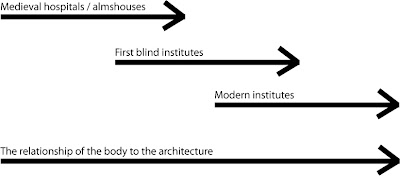
The theme of my history thesis will be: the evaluation of the blind institute throughout the years, looking from the perception of Merleau-Ponty's "body" in the architecture. After two weeks of research I narrowed the search down to the evaluation of the almshouse which linked Blindness with mental patients. In these times blindness was thought off as a blindness of the mind or 'ate' (greek word for blindness and later on for mental blindness). The people who weren't lucky to be helped by family or neighbors came to temples and monasteries who had place for helping the sick and the poor. Later on this evolved in the almshouse. Around 1700 the first blind institutes started to appear. These institutes evolved from small initiatives (mostly in already existing buildings) to the modern institutes we have today.

The structure for the history thesis will be for now:

Explore Lab 9 Fascination!

PROBLEM STATEMENT : How can literature enrich architecture with an phenomenological understanding of space?

RESEARCH // The first part of the project will consist out of two researches. First I start to research Literature as an tool for architectural design. By using the methodology a writer possesses to construct a narrative (like perspective, character, time, description, etc.) and using the freedom writing provides in designing, I’m capable of looking through the eyes of the users and see possible futures for the design.

The second research topic will be about phenomenology and more precise about the body in architecture. Using the theories of Maurice Merleau-Ponty and other philosophers of phenomenology, I’m trying to find the influence the body (and with it the senses) has on architecture. This topic will be combined with my history thesis. For this thesis I’m searching for the development of the body in architecture throughout history.

The results of these two researches will deliver a framework and the basis of information for the design in the second part of the project.

DESIGN // The second part of the project is the design part. After reading ‘the eye of the skin’ from Juhani Pallasma I started to question the dominancy of the eye over the other senses. According to the book, the eye is the only sense that can keep up with the speed of our modern technological world. This is clearly seen in contemporary architecture, where all the cities starting to look like the same image. But also in our everyday live we see the importance of the image over everything else. Just think of the fashion world where the ‘I’ is thought of as ‘how we appear’.

Because of my critique on the dominancy of the eye I‘ve decided to put more attention on the other senses. To do this I choose to take away the eye in the form of designing a institute for the blind.